Enrique Peñalosa always explains that he was born 1954 in Washington DC, because at the time his 24-yo. father, Enrique Peñalosa Camargo, worked for the World Bank.
As many members of the political elites, he started his education in Bogota at Gimnasio Moderno where his father also studied. However, when he was 15, his family suddenly had to leave Colombia because his father, who was the Minister of Agriculture for the Administration of President Carlos Lleras, had been accused of corruption and the consequent political scandal was of such intensity that almost forced the resignation of the President of the Republic. In an attempt to stop the debate and saving his administration, Carlos Lleras decided to send him to Washington as an ambassador’s’ attaché. As result, young Enrique Peñalosa was brought by his parents to the US where he completed his Secondary.
After completing his high school studies, he enrolled in Duke University thanks to a soccer scholarship. After 4 years of studies and representing the university in soccer competitions, he obtained a Bachelor of Arts degree in history and economics. By this time, he was 21 and became conscious of the fact that if he wanted to take advantage of his pollical extraction and make a political career in Colombia he had to resign to his American citizenship, so he did. This turned out to be the wisest decision of his life.
According to his own accounts, he could not find a professional job in the US because one of his professors had labelled him “a communist” even though he had stopped being one before he joined the university. Ironically for him, despite being the member of a wealthy family, Enrique Peñalosa had no other option but to accept menial jobs as cleaner, dish washer or selling shoes during his time in the USA.
At the age of 23, and disappointed because of the “impossibility” of finding a job other than a low rank labourer he left the US in 1977. At that point he decided to travel to England with the intention of roaming the Old Continent as a backpacker. Shortly after that, he discovered Paris and fell in love with City of Light, so much that he said to himself “I will not leave this place”. In Paris, he lived in a ‘chambre de bonne’ on the Rue de Poissoniers where he tells he had to share bathrooms with African migrants. In Paris, he did not sit idle, he obtained a job in a hotel at night as porter and also worked cleaning floors and washing dishes in Dunkin Donuts, and during the day he worked as research assistant for the Inter-American Development Bank. From Paris, he actively participated in the politics of his country by writing articles that he sent to Nueva Frontera, a magazine owned by former president Carlos Lleras and whose deputy director was Luis Carlos Galán. He used his free time to complete master and doctorate studies in Public Administration at the University of Paris II (Pantheon-Assas).
In 1980, he returns to Bogotá and starts his participation in politics by joining the new party created by Luis Carlos Galán, at that time he obtains his first job as a manager in an agricultural company that produces tomatoes in green houses. This same year he gets a job as lecturer in economy at the Universidad Externado de Colombia. In 1981 he gets married.
Between 1982 and 1985, he worked for a number of public organisations, he was researcher for ANIF (National Association of Financial Institutions), subdirector of the Department of Planning of Cundinamarca, Deputy of the Bogota Assembly, vice president of the Aqueduct of Bogota, dean of the Faculty of Administration of the Universidad Externado de Colombia among other jobs.
According to him, 1986 was his best year, his daughter was born, he was elected Councillor for the District of Bogota, he won the Simon Bolivar Journalism Prize from El Espectador, and was chosen as economy advisor by the newly elected President Virgilio Barco (1986-1990), who was a close friend of his father. During this time, he published two books, a first one titled “Democracy and Capitalism: challenges for the next century” around 1987, and a second one with the title “Capitalism, the best option?”
During the 90’s Enrique Peñalosa put his name forward as pre-candidate for the liberal party for the position of Mayor of Bogotá; he lost at every attempt against more experienced and articulated candidates. In 1994 Peñalosa along with other influential members of the Colombian society signed a letter supporting Alvaro Uribe’s proposal for legalizing the so-called self-defence paramilitary groups under the name of CONVIVIR, a word that means ‘coexist’.
Finally, in 1997 he wins the elections for mayor of Bogota after a campaign in which he promised to solve the mobility problems of the city by building the first metro line. During the campaign he presented himself as a candidate without any links to the political elites and as a technocrat, this latter assertion supported by his own claims that he was the only candidate to hold a PhD in Public Administration. Once in charge as mayor, Peñalosa did not build the subway he promised and instead he deviated the moneys that President Ernesto Samper had approved for the construction of the subway line to the construction of Bus Rapid Transit, which he later revealed he had secretly planned before the elections based on the Curitiba model. He named the Bogota system Transmilenio meaning ‘transportation for a millennium’. He justified his ‘sudden’ change in plans by claiming that the BRT was much cheaper and faster than a subway. This manoeuvre was illegal, but he proudly described it during an interview to journalist Jairo Gomez as it was a master stroke. The interview was published in a book titled “Transmilenio, the Jewel of Bogota”.
The approximately 48 km of BRT that Peñalosa built brought some temporary order to the chaotic traffic of the Caracas Avenue of Bogotá and for this reason when Peñalosa ended its term as a mayor in 2000, the media labelled it as a success.
After the construction of the BRT system in Bogotá Peñalosa became a BRT consultant for Volvo and years later he was appointed CEO for the ITDP in New York, from where, using the experience of Bogotá as a showcase, he travelled around the world to convince every city he visited of building BRT systems instead of subways or metro lines.
In the meantime, Transmilenio started to show serious problems, the first one was the quickly deterioration of the concrete bus lanes that were supposed to last 20 years but that had cracked and were broken after two years of heavy use. The cost of rebuilding the bus lanes was a financial burden to the city which had to divert the money required to build more BRT routes to the maintenance of the defective concrete lanes.
As the problems with Transmilenio mounted and its capacity was saturated, the deficiencies and inadequacies of the BRT system became known worldwide. And although successive administrations of Bogotá more than doubled the extension of Transmilenio, Peñalosa who was a true believer of the superiority of BRT over subways accused them not making enough investment and efforts to expand and improve the system and attacked them for their ‘ridiculous’ plans for building an ‘unnecessary’ subway.
In 2007 he decided to participate in the Bogotá elections for the term 2008-2011 with the promise of fixing Transmilenio. However, he lost the election to the leftist candidate Samuel Moreno who had promised to build the subway. Moreno’s metro was not built because he was accused of corruption, his administration was in disarray and he ended up in jail. Peñalosa tried in the 2011 elections but lost again, this time against Gustavo Petro. Petro, a highly influential left-wing politician invested his political efforts in the planning and design of the underground line which by the end of his term in 2015 was in an advanced state and ready for tender.
Peñalosa tried his luck in the 2015 elections, and yet again he promised to start building the metro line from the first year of his administration and to fix all the Transmilenio problems. Similarly, he launched a campaign in which presented himself as the only Colombian politician to hold a PhD in public administration and now he was claiming an extensive experience as designer of urban spaces around the world. He obtained the united support the right-wing parties of Alvaro Uribe and German Lleras who were determined to defeating the left-wing candidates. Peñalosa won the elections with just 33% of the votes.
In January 2016, he took charge of his position as mayor of Bogota, which started with controversy because he was the CEO of the ITDP. Several days after his possession and due to intense public pressure, he reluctantly resigned to his position at the ITDP.
Peñalosa’s first administrative decision as mayor was to suspend the metro project started by his leftist predecessor. This decision was supported by President Juan Manuel Santos and the right-wing establishment, who agreed with Peñalosa that Bogotá was a too poor city to undertake the construction of an underground.
However, this controversial act caused a great deal of discontent among the population of Bogotá who did not buy the argument of poverty as an excuse to not build the subway because it was well known that poorer cities in the Americas had already built or were in the process of building subways. As a consequence, Peñalosa lost credibility as an honest politician. A few popular movements were created with the intention of calling for his removal as a mayor and started to collect signatures for a recall election.
Despite all this, Peñalosa did not stop there, he also suspended among many other projects the construction of several tramways, the restoration of old railway lines and the purchase of over 600 electric buses.
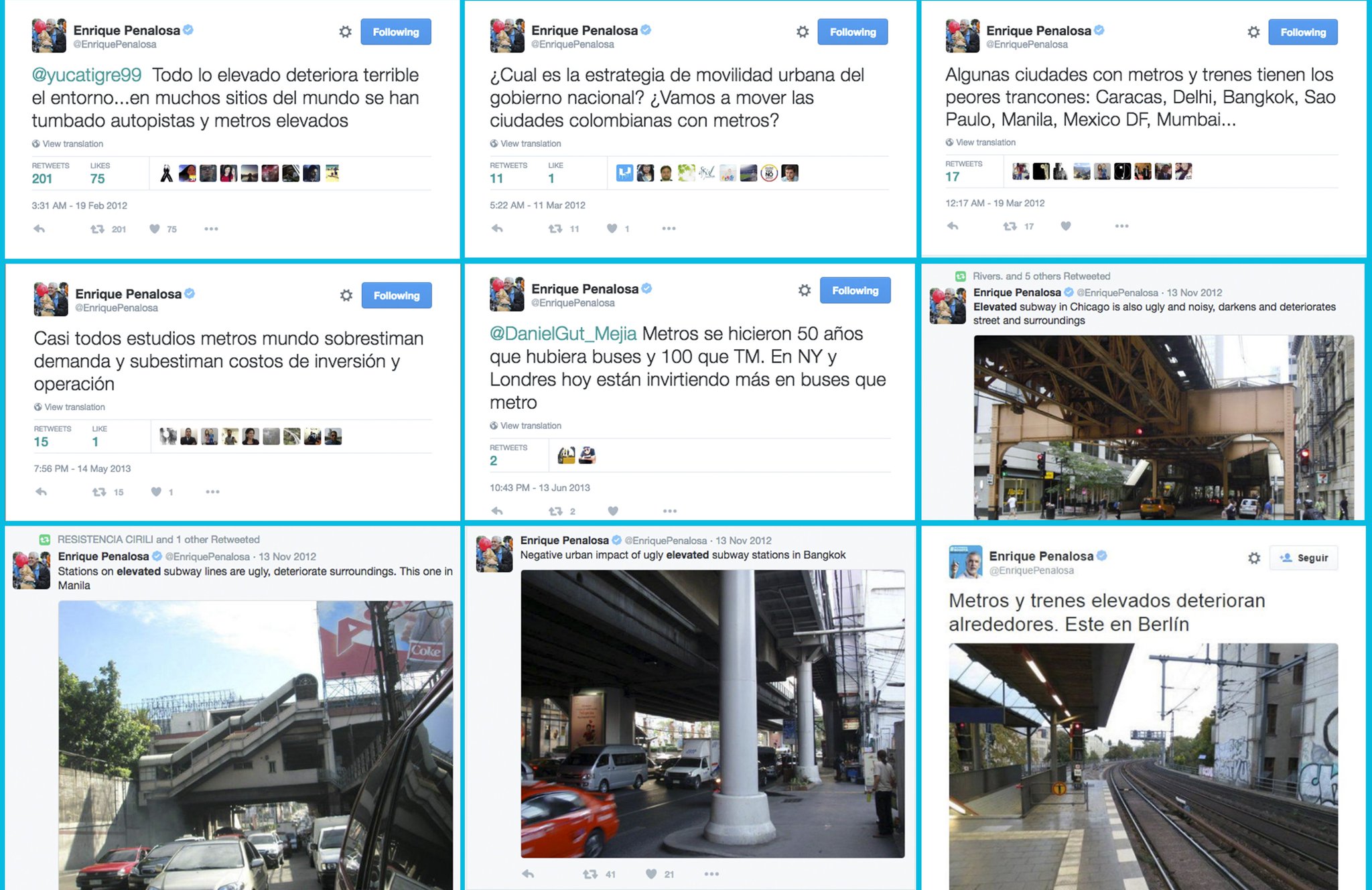
His explanations on the media exacerbated the discontent among the population, he said that that “trams were a cancer everywhere” and that “people thought that subways were good because they did not know about them”, he also said that in reality “subways were stinky rat holes were people urinated around”.
A few months later, two academic researchers published an article in El Espectador, Colombia’s second largest newspaper exposing inconsistencies in the mayor’s public résumé, particularly in relation to his claims of having completed master and PhD degrees in Public Administration in Paris. The researchers were suspicious about the timeline of his CV and the large number of activities Peñalosa claimed to have done during the three years he spent in Paris. These revelations fueled the support for the recall election and caused panic among the establishment. Alvaro Uribe travelled to Bogotá to show his support for Peñalosa and to provide some advice to him on how to handle the public opinion. Peñalosa started to talk again about building a metro, but this time it was going to be an elevated metro of his own design and he promised to start building it within six months if he was not removed from his position.
Peñalosa was also hard pressed to publicly admit that he had not undertaken Master of PhD studies in Paris and although his false academic claims constitute a crime under the Colombian law, the investigation against him was let to expire and was archived by the Chief Prosecutor Humberto Martinez Neira a close friend of his.
It was revealed by some politicians within German Lleras party that the reason for the suspension of all the projects that the Petro administration had initiated was the believe among the establishment that if these projects were successful Petro would win the next presidential elections, a hypothetical but likely situation that an elitist establishment that has been in control of the country’s institutions for over two centuries considered catastrophic.
With similar arguments, the recall election against Peñalosa was stopped by the Electoral Commission in violation of the constitution despite the fact that its promoters collected twice the number of signatures required for its approval. The decision was based on a technicality, that the receipts for the snacks consumed by the organizers during the recall elections campaign were not provided.
The establishment was certain that if the recall election took place Peñalosa would lose and that this event would trigger a catastrophic domino effect that would end up with the country and its institutions falling in the hands of the left parties or ‘the terrorists’ as some right-wing politicians normally refer to them.
Peñalosa’s image and reputation remains in tatters. The new President Ivan Duque has seen his own image affected in a negative way for publicly declaring support for Peñalosa and other corrupt politicians. By January 2019, Peñalosa had not yet fulfilled the main promises made during his campaign which he reiterated in the most critical moment of his administration of starting to build a metro within six months if he was not removed. Similarly, he had not fixed the problems of mobility of Bogotá which he promised to fix in one month, nor he had added one more kilometre to the length of Transmilenio despite asserting repeatedly that it is the transport of the future.


 This is translation of an article published in El Espectador. Original written by Yohir Akerman can be found at the following URL: